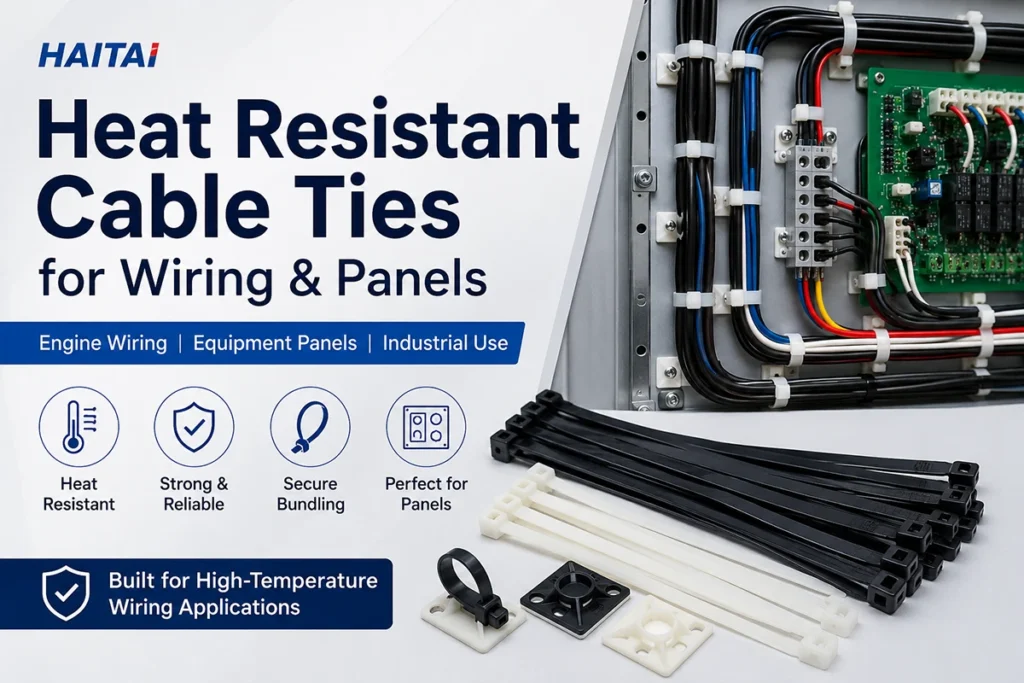






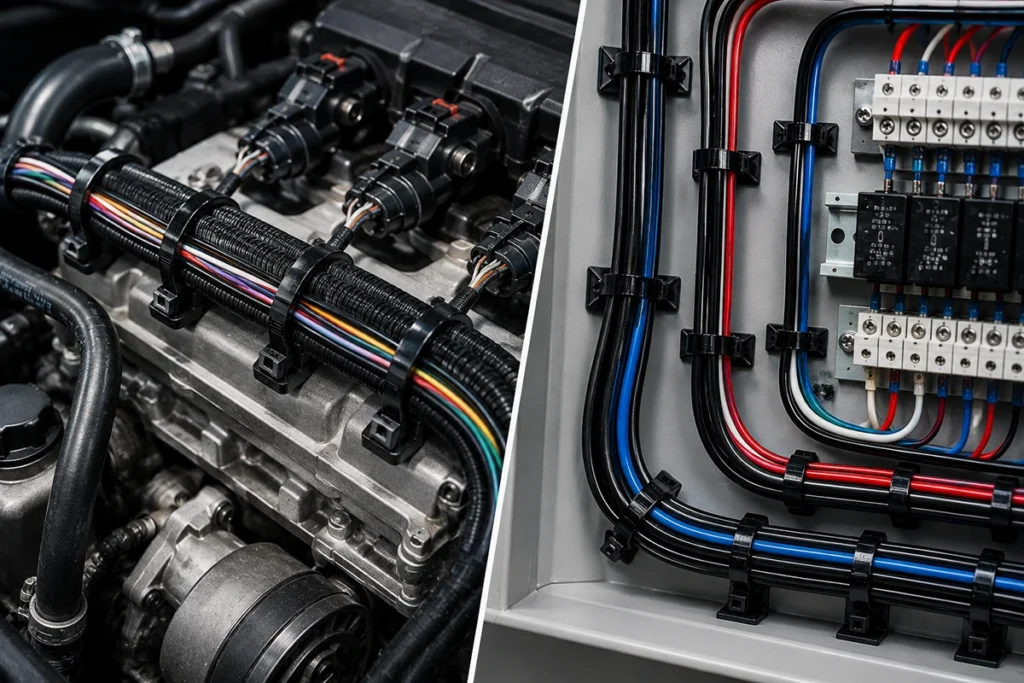
For engine wiring and equipment panels, choose heat resistant cable ties by the temperature at the fastening point, exposure duration and bundle requirements. Haitai’s heat-stabilized PA66 cable ties have a 130°C continuous operating upper limit and an installation range of −20°C to +85°C; for a different temperature profile, compare the PA46 high-temperature range before selecting a model.
Installation temperature describes conditions while fitting the tie, not its in-service temperature limit. Record continuous temperature in °C and any peak exposure in °C and hours separately, then confirm dimensions, loop tensile strength and environmental compatibility.
Why Heat Resistance Matters in Cable Tie Selection
PA66HS means heat-stabilized polyamide 66; it is a material category, not one universal finished-tie rating. For Haitai’s PA66HS range, the confirmed continuous operating upper limit is 130°C, while the selected model must still match the fastening point and mechanical requirements.
Assess temperature at the tie’s actual location rather than relying only on a general engine-bay or cabinet reading. Include vibration, contact with chemicals and proximity to hot surfaces in the application brief; a higher temperature rating does not by itself establish chemical compatibility or retained tensile strength.
Common Applications for Heat Resistant Cable Ties
Heat resistant cable ties are often used in places where the wire bundle must stay fixed for a long time without shifting. Common applications include:
- Engine compartment wiring
- Automotive service harnesses
- Equipment panels
- Control cabinets
- Industrial machinery
- Power distribution boxes
- HVAC equipment wiring
- Electrical appliances with warm internal zones
In these environments, neat cable management is only one part of the job. The tie also needs to resist heat aging, vibration, oil mist, dust, and repeated operating cycles.
Engine Wiring Needs More Than a Strong Tie
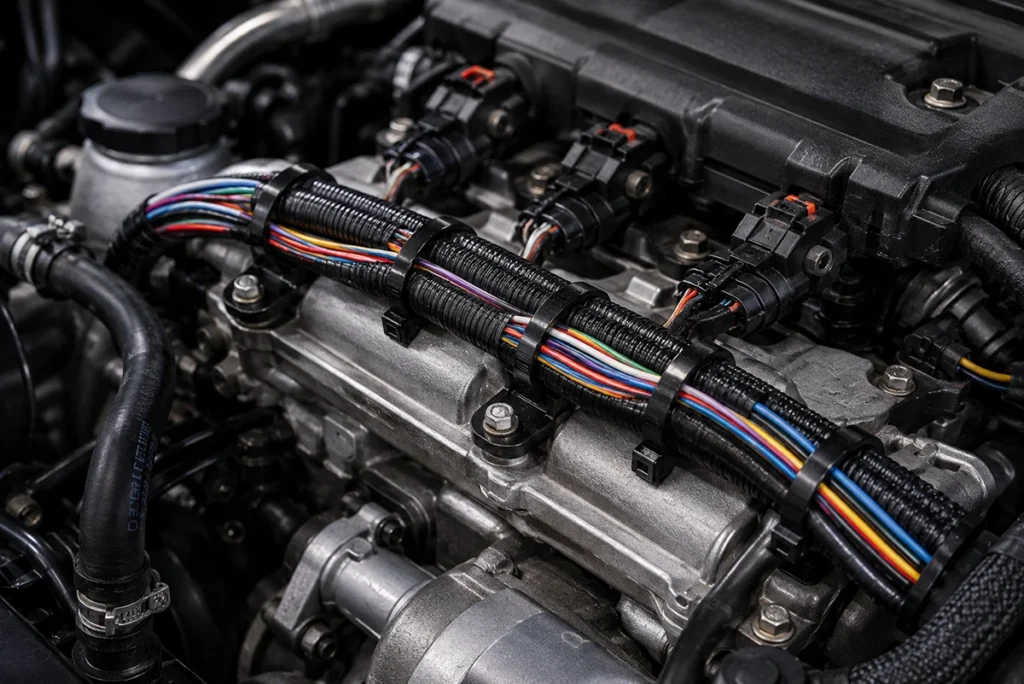
Engine wiring is one of the most demanding uses for cable ties. The area may be compact, hot, and difficult to service. A harness may run near metal brackets, hoses, plastic covers, and moving parts. If the tie loosens, the bundle can rub against nearby components.
For engine-side routing, buyers should look for:
- Heat stabilized PA66 material
- Correct width for the bundle load
- Smooth edges to reduce wire jacket damage
- Strong locking performance
- Stable quality across repeat orders
- Optional mountable or push-mount cable ties when fixed routing is needed
The tie should not be placed directly against an extreme heat source if the surrounding temperature exceeds the material rating. In that case, routing should be adjusted, or a different fastening solution may be needed.
Equipment Panels and Control Cabinets
For enclosed equipment panels, compare the measured temperature at the fastening point with the selected model’s operating limit. Haitai’s PA66HS cable ties have a 130°C continuous operating upper limit; this does not mean every location in a cabinet requires a high-temperature tie.
For panel wiring, check:
- Bundle diameter and routing space in mm.
- Strap width × length and locking-head clearance.
- Required loop tensile strength in N and relevant test conditions.
- Mounting position, maintenance access and installation-tool settings.
- Color identification, pack quantity and labels for repeat orders.
Review heat-stabilized PA66 cable tie specifications to select a product, and use the engine-compartment application guide when planning automotive routing.
Heat Resistant vs Flame Retardant Cable Ties
These two terms are easy to confuse. Heat resistant cable ties are designed to perform better in elevated temperatures. Flame retardant cable ties are designed to meet flame resistance requirements.
They are not the same thing.
A heat resistant tie may not be flame retardant. A flame retardant tie may not be the best choice for continuous high-temperature use. If the application involves electrical equipment, fire performance, or specific compliance requirements, buyers should confirm the material grade, test report, and intended working environment before ordering.
Quick Selection Guide
Compare Haitai PA66HS and PA46 temperature limits
| Product range | Continuous operating upper limit | Installation temperature | Limited-duration high-temperature exposure |
|---|---|---|---|
| Heat-stabilized PA66 / PA66HS | 130°C | −20°C to +85°C | No additional peak rating specified here |
| PA46 high-temperature cable ties | 150°C | Confirm for the selected model | 195°C for up to 500 hours |
These are Haitai’s stated limits for the named product ranges, not universal ratings for all PA66 or PA46 cable ties. The 195°C / 500-hour figure must not be presented as unlimited continuous operation or as the installation temperature.
Match the material to the application
| Application | Main Risk | Suggested Cable Tie Type | Buyer Note |
|---|---|---|---|
| Engine wiring | Heat and vibration | Heat stabilized PA66 cable ties | Check temperature rating and bundle load |
| Equipment panels | Warm enclosed space | Standard or heat resistant cable ties | Choose based on cabinet temperature |
| Industrial machinery | Heat, oil mist, movement | Heat resistant cable ties | Consider wider ties for heavier bundles |
| Near exhaust or turbo areas | Extreme radiant heat | Special fastening solution | Do not rely only on nylon ties |
| HVAC equipment | Warm airflow and vibration | Heat stabilized cable ties | Confirm aging performance |
| Service harnesses | Rework and maintenance | A releasable design only if its own temperature rating matches the application | Choose based on service frequency |
How to Choose the Right Size
Start with minimum and maximum bundle diameter in mm, then specify strap width × length and locking-head clearance. Use the cable tie size chart to prepare the dimensional requirement, but confirm the PA66HS or PA46 version of the selected model rather than transferring a standard PA66 specification.
State the required loop tensile strength in N together with the application temperature and relevant conditioning. Loop tensile strength is not a safe working-load rating; the cable tie tensile strength guide explains the purchasing information to request.
Include an installation photo or drawing if the tie must fit a panel hole, bracket or restricted space. Dimensions, material and environmental requirements should be agreed together before sample approval.
Material and Color Considerations
PA66HS identifies heat stabilization; black or natural color does not by itself establish UV resistance. If sunlight exposure is expected, specify it separately and request the relevant documentation for the selected compound and finished model.
Treat temperature, UV exposure and flame classification as separate requirements rather than interchangeable claims. The PA66 versus UV-resistant cable tie guide provides a separate outdoor-selection checklist.
Installation Mistakes to Avoid
Even a good cable tie can fail early if installed incorrectly. In hot areas, small installation mistakes become bigger over time.
Avoid these common problems:
- Installing the tie too close to a direct heat source
- Pulling the tie so tight that it damages wire insulation
- Using a tie that is too narrow for the bundle
- Leaving the locking head against a sharp edge
- Mixing different material grades in one production batch
- Choosing only by length instead of width and strength
- Ignoring vibration and movement after installation
A good installation should hold the harness firmly without crushing it. The bundle should stay in place, but the wire jacket should not be pinched or deformed.
What Buyers Should Confirm Before Ordering
For a bulk or OEM quotation, provide the material range, strap width × length in mm, bundle diameter in mm and required loop tensile strength in N. State installation temperature, continuous operating temperature and any higher-temperature exposure with its duration separately.
Include:
- Quantity by model and color.
- Contact with oil, cleaning agents or other chemicals.
- Sunlight exposure and any required flame classification.
- Pack quantity in pcs/bag, carton marks and private-label artwork.
- Required drawings, test conditions and model-specific certificate scope.
- Sample-approval requirements, destination and requested delivery date.
Request heat resistant cable tie samples or a quotation from Haitai with these details. Specify PA66HS or PA46 so the reply can be matched to the correct material and temperature profile.
Final Thoughts
Heat Resistant Cable Ties are a small part of the wiring system, but they have a direct effect on routing quality and long-term reliability. For engine wiring, equipment panels, and industrial harnesses, the right cable tie should match the heat level, bundle size, fastening load, and installation space.
If the application is close to heat, vibration, or enclosed electrical components, do not choose by price or length alone. Start with the working environment, then confirm the material, size, strength, and packaging. That is the safer way to build a cable management solution that works in production and stays reliable in service.
FAQ
What are Heat Resistant Cable Ties used for?
They are used to bundle wiring in temperature-exposed locations such as equipment panels, industrial machinery and selected engine-compartment positions. Haitai’s PA66HS range has a 130°C continuous operating upper limit; check the specific fixing point rather than assuming every location has the same conditions.
Are heat resistant cable ties the same as UV resistant cable ties?
No: heat stabilization and UV resistance address different exposure requirements. If both are needed, confirm both properties for the selected compound and finished model; color alone is not evidence.
What material is common for heat resistant cable ties?
Heat-stabilized PA66 (PA66HS) is one option; Haitai specifies a 130°C continuous operating upper limit and −20°C to +85°C installation for this range. Haitai’s separate PA46 range has a 150°C continuous operating upper limit and permits 195°C for up to 500 hours, not unlimited service at 195°C.
Can I use standard nylon cable ties in an engine compartment?
Only if the selected finished tie’s documented temperature and environmental limits cover the actual fixing point. Do not assume standard PA66 and PA66HS share the same rating, and do not use a loop tensile figure as a safe working-load rating.
How do I choose the right size?
Provide bundle diameter, strap width × length and available routing clearance in mm, plus the required loop tensile strength in N. Confirm these with the selected heat-resistant material and test conditions, rather than selecting by length alone.