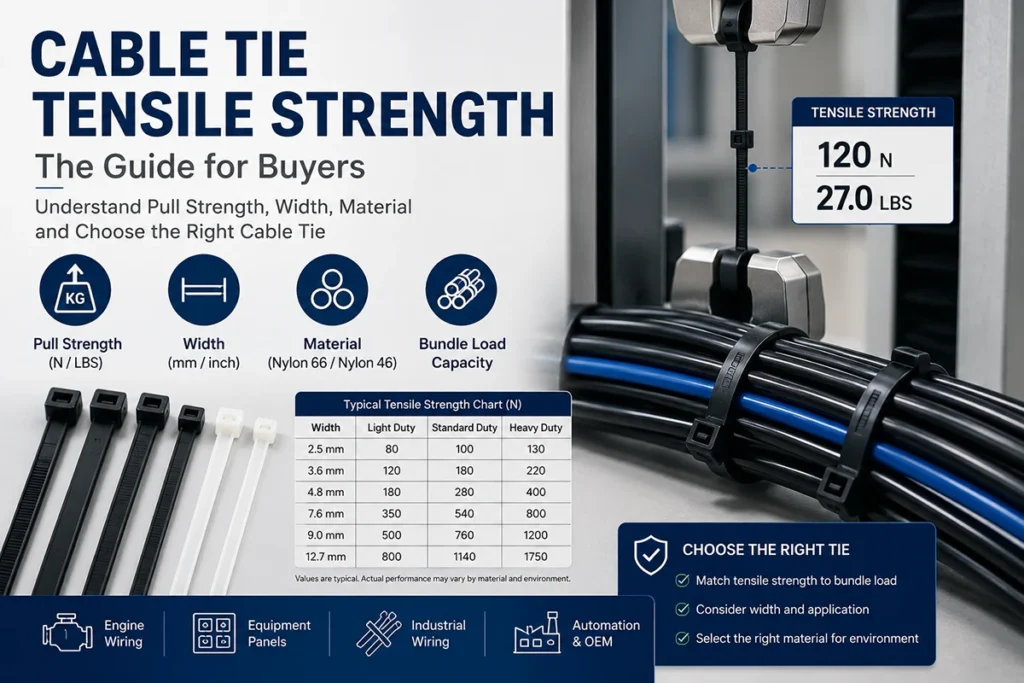






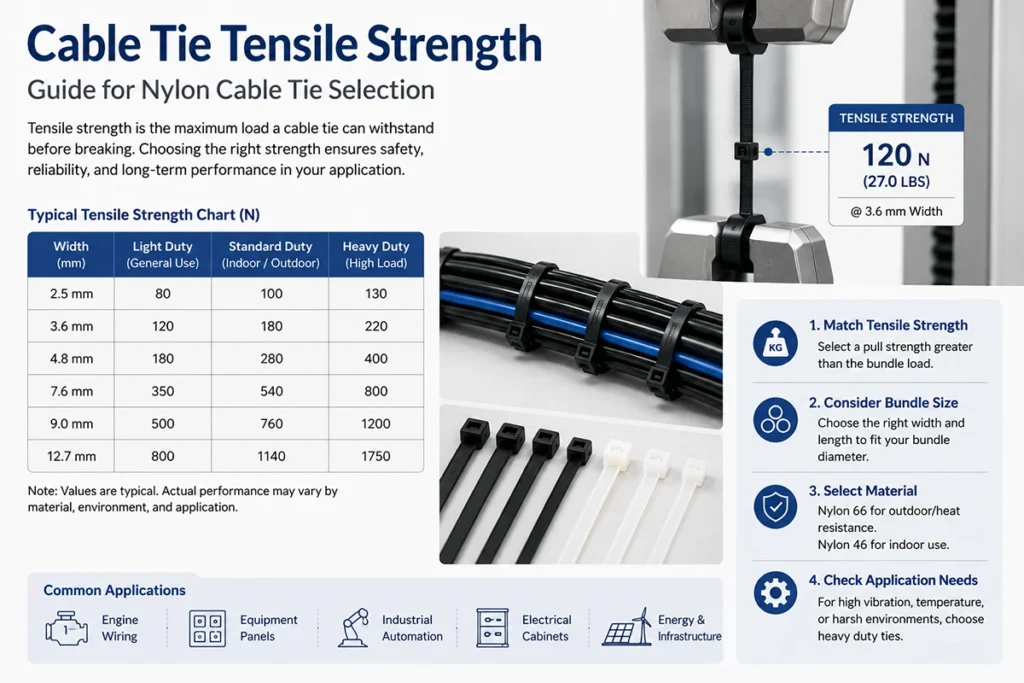
Cable Tie Tensile Strength is one of the first things buyers should check when choosing nylon cable ties for wiring, equipment, and industrial bundles. Length tells you whether the tie can wrap around the bundle, but tensile strength tells you whether it can actually hold the bundle under pulling force, vibration, movement, or daily handling.
For many projects, a cable tie is a small part of the bill of materials. But if the strength is wrong, the result can be loose wiring, broken fastening points, difficult maintenance, or failed inspection. This guide explains what cable tie tensile strength means, how width and material affect holding performance, and how buyers can choose light duty, medium duty, or heavy duty cable ties for different applications.
What Cable Tie Tensile Strength Means
Cable tie tensile strength refers to the pulling force a cable tie can withstand before it breaks or fails at the locking head. In simple terms, it tells you how much load the tie can handle when the strap is pulled in tension.
This is not the same as bundle size. A long cable tie can wrap around a large bundle, but it may still be too narrow or too light for the job. A shorter but wider cable tie may offer stronger holding performance in the right application.
For a general explanation of cable tie structure and use, you can refer to this external resource: Cable tie.
Why Tensile Strength Matters in Real Applications
In a clean desk test, almost any cable tie may look strong enough. Real applications are different. Wires can move during installation. Equipment can vibrate. Harnesses can be pulled during service. Outdoor or industrial routes may face temperature changes, dust, moisture, or repeated handling.
Cable Tie Tensile Strength matters because it helps prevent:
- Loose wire bundles
- Broken fastening points
- Cable movement during vibration
- Poor-looking harness routing
- Stress on connectors
- Wire jacket abrasion
- Service and maintenance problems
For household, light electrical, and control panel wiring, medium strength may be enough. For industrial equipment, large harnesses, or heavy cable runs, buyers usually need stronger and wider cable ties.
Width, Material, and Locking Head All Matter
Many buyers only check cable tie length, but width is often the better clue for strength. In most nylon cable ties, wider ties usually provide higher tensile strength because the strap has more material and the locking head is larger.
Material also matters. Standard PA66 nylon is widely used for general cable ties. Heat stabilized PA66, UV resistant PA66, and other modified materials may be selected for special environments. The same size tie can perform differently depending on the material grade, molding quality, and locking design.
When comparing cable ties, check these points:
- Strap width
- Strap thickness
- Locking head design
- Nylon material grade
- Tensile strength rating
- Working temperature
- UV or heat resistance requirements
- Production consistency
If the application is outdoors, near heat, or used in machinery, strength alone is not enough. The environment should also guide the material choice.
Light Duty, Medium Duty, and Heavy Duty Cable Ties
Cable ties are often described as light duty, medium duty, or heavy duty. These names are useful, but buyers should still check the actual strength rating and size.
Light Duty Cable Ties
Light duty cable ties are used for small wires, signal cables, retail packaging, and simple organizing work. They are easy to install and suitable for low-load applications.
Best for:
- Small wire groups
- Signal wires
- Light appliance wiring
- Office or home cable management
- Retail packing and display use
Medium Duty Cable Ties
Medium duty cable ties are the most common choice for general wiring and equipment assembly. They offer better holding strength while still being easy to handle.
Best for:
- Electrical panels
- General harness routing
- Appliance wiring
- Equipment assembly
- Maintenance work
Heavy Duty Cable Ties
Heavy duty cable ties are used when the bundle is larger, heavier, or exposed to movement. They usually have wider straps and stronger locking heads.
Best for:
- Industrial wire bundles
- Large cable harnesses
- Machinery routing
- Outdoor equipment
- Heavy cable management
- Applications with vibration or pulling load
Internal link suggestion: link to nylon cable tie products when mentioning available cable tie sizes and types.
Cable Tie Tensile Strength Selection Chart
| Bundle Need | Typical Tie Width | Strength Level | Best Use |
|---|---|---|---|
| Small signal wires | 2.5-3.6 mm | Light duty | Control panels, small electronics |
| General wire harness | 3.6-4.8 mm | Medium duty | Appliances, equipment wiring |
| Thick cable bundle | 4.8-7.6 mm | Heavy duty | Industrial routing, machinery |
| Outdoor cable run | 4.8-7.6 mm | UV resistant / heavy duty | Solar, outdoor equipment |
| Engine-side wiring | 3.6-7.6 mm | Heat stabilized | Automotive and hot-area routing |
| Large industrial bundle | 7.6 mm+ | Heavy duty | Heavy cable management |
Use this chart as a starting point. Final selection should depend on bundle diameter, cable weight, routing space, installation method, and required safety margin.
Do Not Choose by Length Only
A common mistake is choosing cable ties only by length. Length is important because the tie must wrap around the bundle and leave enough tail for locking. But length does not tell you how much force the tie can hold.
For example, a long narrow cable tie may fit around a large bundle, but it may not have enough tensile strength. A wider tie with a stronger locking head may be a better choice, even if the length is similar.
Before ordering, check:
- Bundle diameter
- Bundle weight
- Wire type
- Cable movement
- Installation space
- Required pull strength
- Temperature and UV exposure
- Whether the tie needs a mounting hole or fixed base
For size selection, you can also link to the related internal article: cable tie size guide.
When Buyers Should Choose Heavy Duty Cable Ties
Heavy duty cable ties are not always necessary, but they are useful when failure would cause real problems. If a cable bundle is large, moves often, or sits in a demanding area, a stronger tie is usually worth the small cost difference.
Choose heavy duty cable ties when:
- The bundle is thick or heavy
- The route has vibration
- The tie is holding multiple cables
- The wiring is used in machinery
- The installation is hard to access later
- The bundle must stay fixed for long service life
- The application has outdoor or industrial exposure
For OEM buyers, heavy duty cable ties can also reduce maintenance complaints when the application is known to have movement or pulling force.
Installation Tips for Better Holding Strength
Even the right cable tie can fail early if it is installed badly. Over-tightening can damage wire insulation. Under-tightening can allow movement. Cutting the tail badly can leave a sharp edge.
Good installation practice includes:
- Use the correct tie width for the bundle
- Do not overtighten small wires
- Keep the locking head away from sharp edges
- Cut the tail cleanly after installation
- Use a cable tie tool for repeat assembly
- Avoid placing the tie directly on hot surfaces
- Use mounting ties when the bundle must stay in a fixed route
For production work, a tensioning tool can help keep installation force consistent. This is useful when the same cable tie is used across many harnesses or panel assemblies.
What to Confirm Before Bulk Ordering
Before placing a bulk order, buyers should confirm the technical and packaging details. This avoids ordering cable ties that look correct but do not match the actual application.
Ask the supplier to confirm:
- Tensile strength
- Length and width
- Material grade
- Color
- Temperature rating
- UV resistance if needed
- Packaging quantity
- Label and carton requirements
- Sample availability
- Certificate or test report requirements
Haitai can support cable tie buyers with different sizes, colors, packaging options, and application-based recommendations for wiring, equipment, automotive, solar, and industrial use.
Final Thoughts
Cable Tie Tensile Strength is not just a technical number. It is a practical guide for choosing the right fastening solution for real wire bundles. A tie that is too weak may fail. A tie that is too large may be difficult to install or unnecessary for the application.
The best choice comes from matching strength, width, material, and environment. For small wires, light duty ties may be enough. For general harnesses, medium duty ties are usually practical. For machinery, outdoor routing, and large cable bundles, heavy duty cable ties are often the safer option.
If you are not sure which tensile strength to choose, start with the bundle size and working environment, then confirm the tie width and material grade before ordering.
FAQ
What is Cable Tie Tensile Strength?
Cable Tie Tensile Strength is the pulling force a cable tie can withstand before the strap or locking head fails. It helps buyers choose the right tie for different bundle loads.
Is a wider cable tie always stronger?
Usually, wider cable ties have higher tensile strength, but material grade, strap thickness, and locking head design also affect performance.
Should I choose cable ties by length or strength?
Both matter. Length decides whether the tie can wrap around the bundle. Tensile strength decides whether it can hold the bundle reliably.
When should I use heavy duty cable ties?
Use heavy duty cable ties for thick bundles, industrial wiring, machinery, vibration-prone areas, outdoor equipment, and installations that are difficult to repair later.
Are nylon cable ties strong enough for industrial use?
Yes, nylon cable ties can be suitable for industrial use when the correct tensile strength, size, and material grade are selected for the application.