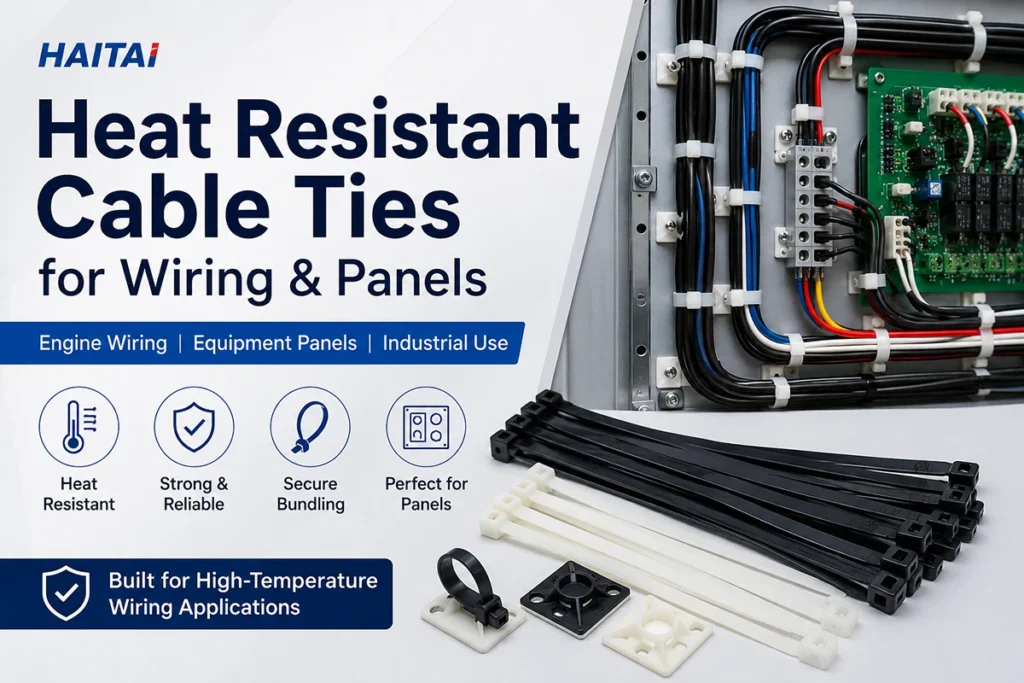


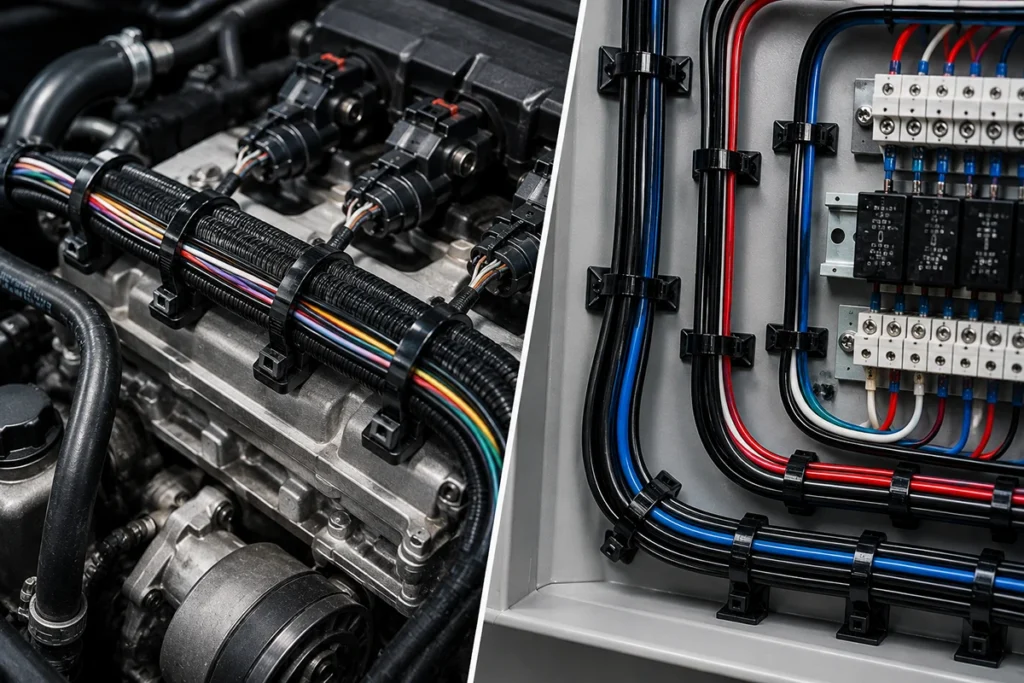
For engine wiring and equipment panels, choose heat resistant cable ties by the temperature at the fastening point, exposure duration and bundle requirements. Haitai’s heat-stabilized PA66 cable ties have a 130°C continuous operating upper limit and an installation range of −20°C to +85°C; for a different temperature profile, compare the PA46 high-temperature range before selecting a model.
Installation temperature describes conditions while fitting the tie, not its in-service temperature limit. Record continuous temperature in °C and any peak exposure in °C and hours separately, then confirm dimensions, loop tensile strength and environmental compatibility.
Por qué la resistencia al calor es importante en la selección de bridas
PA66HS means heat-stabilized polyamide 66; it is a material category, not one universal finished-tie rating. For Haitai’s PA66HS range, the confirmed continuous operating upper limit is 130°C, while the selected model must still match the fastening point and mechanical requirements.
Assess temperature at the tie’s actual location rather than relying only on a general engine-bay or cabinet reading. Include vibration, contact with chemicals and proximity to hot surfaces in the application brief; a higher temperature rating does not by itself establish chemical compatibility or retained tensile strength.
Aplicaciones comunes para bridas resistentes al calor
Las bridas resistentes al calor se utilizan a menudo en lugares donde el mazo de cables debe permanecer fijo durante mucho tiempo sin moverse. Las aplicaciones comunes incluyen:
- Compartimiento del motor cableado
- Arneses de servicio automotriz
- Paneles de equipos
- Gabinetes de control
- Maquinaria industrial
- Cajas de distribución de energía
- Cableado de equipos HVAC
- Aparatos eléctricos con zonas internas cálidas
En estos entornos, una buena gestión de cables es solo una parte del trabajo. La brida también debe resistir el envejecimiento por calor, la vibración, la neblina de aceite, el polvo y los ciclos de funcionamiento repetidos.
El cableado del motor necesita más que una brida fuerte
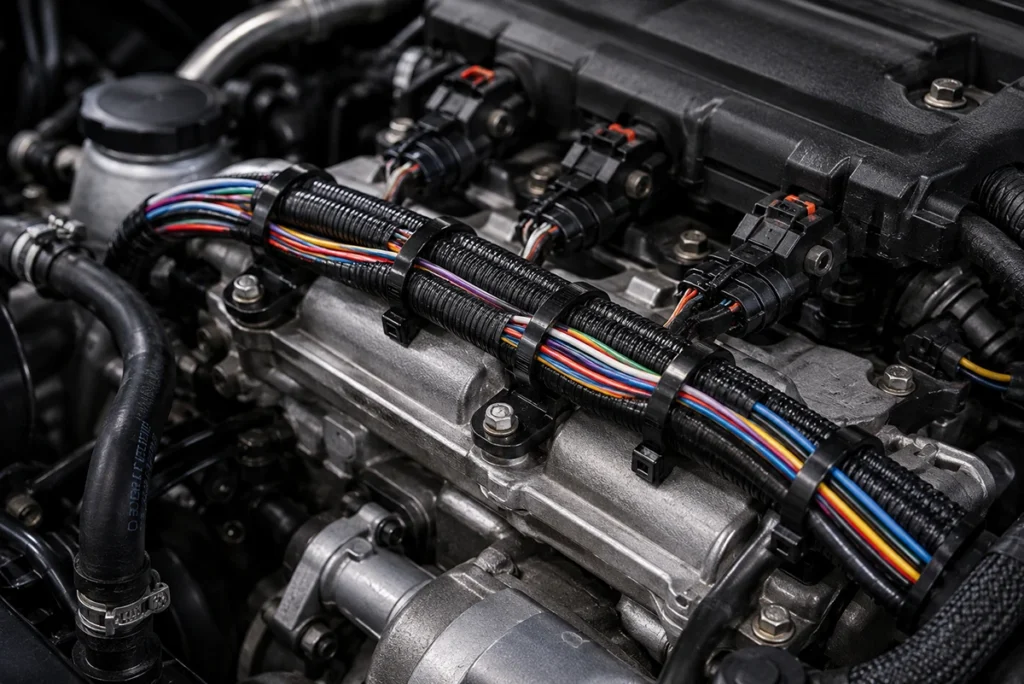
El cableado del motor es uno de los usos más exigentes para las bridas. El área puede ser compacta, calurosa y difícil de reparar. Un arnés puede pasar cerca de soportes metálicos, mangueras, cubiertas de plástico y piezas móviles. Si la brida se afloja, el mazo puede rozar contra componentes cercanos.
Para el enrutamiento del lado del motor, los compradores deben buscar:
- Material PA66 estabilizado al calor
- Ancho correcto para la carga del paquete
- Bordes lisos para reducir el daño a la cubierta del cable
- Rendimiento de bloqueo sólido
- Calidad constante en pedidos repetidos
- Brides de cable opcionales, montables o de empuje cuando se necesita un enrutamiento fijo
La corbata no debe colocarse directamente contra una fuente de calor extremo si la temperatura ambiente excede el índice del material. En ese caso, se debe ajustar el cableado o puede ser necesaria una solución de sujeción diferente.
Paneles de Equipos y Gabinetes de Control
For enclosed equipment panels, compare the measured temperature at the fastening point with the selected model’s operating limit. Haitai’s PA66HS cable ties have a 130°C continuous operating upper limit; this does not mean every location in a cabinet requires a high-temperature tie.
For panel wiring, check:
- Bundle diameter and routing space in mm.
- Strap width × length and locking-head clearance.
- Required loop tensile strength in N and relevant test conditions.
- Mounting position, maintenance access and installation-tool settings.
- Color identification, pack quantity and labels for repeat orders.
Review heat-stabilized PA66 cable tie specifications to select a product, and use the engine-compartment application guide when planning automotive routing.
Bridas resistentes al calor vs. bridas ignífugas
Estos dos términos son fáciles de confundir. Las bridas resistentes al calor están diseñadas para funcionar mejor en temperaturas elevadas. Las bridas ignífugas están diseñadas para cumplir con los requisitos de resistencia a las llamas.
No son lo mismo.
Una brida resistente al calor puede no ser ignífuga. Una brida ignífuga puede no ser la mejor opción para uso continuo a alta temperatura. Si la aplicación involucra equipos eléctricos, rendimiento contra incendios o requisitos de cumplimiento específicos, los compradores deben confirmar el grado del material, el informe de pruebas y el entorno de trabajo previsto antes de realizar el pedido.
Guía de selección rápida
Compare Haitai PA66HS and PA46 temperature limits
| Product range | Continuous operating upper limit | Installation temperature | Limited-duration high-temperature exposure |
|---|---|---|---|
| Heat-stabilized PA66 / PA66HS | 130°C | −20°C to +85°C | No additional peak rating specified here |
| PA46 high-temperature cable ties | 150°C | Confirm for the selected model | 195°C for up to 500 hours |
These are Haitai’s stated limits for the named product ranges, not universal ratings for all PA66 or PA46 cable ties. The 195°C / 500-hour figure must not be presented as unlimited continuous operation or as the installation temperature.
Match the material to the application
| Solicitud | Riesgo principal | Tipo de brida de cable sugerido | Nota del comprador |
|---|---|---|---|
| Cableado del motor | Calor y vibración | Bridas PA66 estabilizadas al calor | Comprobar el índice de temperatura y la carga del paquete |
| Paneles de equipos | Espacio cerrado y cálido | Bridas estándar o resistentes al calor | Elige según la temperatura del gabinete |
| Maquinaria industrial | Calor, neblina de aceite, movimiento | Brida resistente al calor | Considera lazos más anchos para bultos más pesados |
| Cerca de las áreas del escape o del turbo | Calor radiante extremo | Solución de fijación especial | No te fíes solo de bridas de nylon. |
| Equipo de climatización | Flujo de aire cálido y vibración | Bridas para cables estabilizadas al calor | Confirmar rendimiento de envejecimiento |
| Arneses de servicio | Remodelación y mantenimiento | A releasable design only if its own temperature rating matches the application | Elegir según la frecuencia del servicio |
Cómo elegir el tamaño correcto
Start with minimum and maximum bundle diameter in mm, then specify strap width × length and locking-head clearance. Use the cable tie size chart to prepare the dimensional requirement, but confirm the PA66HS or PA46 version of the selected model rather than transferring a standard PA66 specification.
State the required loop tensile strength in N together with the application temperature and relevant conditioning. Loop tensile strength is not a safe working-load rating; the guía de resistencia a la tracción de bridas explains the purchasing information to request.
Include an installation photo or drawing if the tie must fit a panel hole, bracket or restricted space. Dimensions, material and environmental requirements should be agreed together before sample approval.
Consideraciones de Material y Color
PA66HS identifies heat stabilization; black or natural color does not by itself establish UV resistance. If sunlight exposure is expected, specify it separately and request the relevant documentation for the selected compound and finished model.
Treat temperature, UV exposure and flame classification as separate requirements rather than interchangeable claims. The PA66 versus UV-resistant cable tie guide provides a separate outdoor-selection checklist.
Errores de instalación que debe evitar
Incluso una brida de cables de buena calidad puede fallar prematuramente si se instala incorrectamente. En zonas calurosas, pequeños errores de instalación se vuelven más grandes con el tiempo.
Evita estos problemas comunes:
- Instalar la corbata demasiado cerca de una fuente de calor directa
- Tirar de la corbata tan fuerte que dañe el aislamiento del cable
- Usando una brida demasiado estrecha para el paquete
- Dejar la cabeza de bloqueo contra un borde afilado
- Mezclar diferentes grados de material en un solo lote de producción
- Elegir solo por longitud en lugar de por anchura y resistencia
- Ignorar la vibración y el movimiento después de la instalación
Una buena instalación debe sujetar el mazo de cables firmemente sin aplastarlo. El mazo debe permanecer en su sitio, pero la cubierta del cable no debe pellizcarse ni deformarse.
Lo que los compradores deben confirmar antes de realizar un pedido
For a bulk or OEM quotation, provide the material range, strap width × length in mm, bundle diameter in mm and required loop tensile strength in N. State installation temperature, continuous operating temperature and any higher-temperature exposure with its duration separately.
Include:
- Quantity by model and color.
- Contact with oil, cleaning agents or other chemicals.
- Sunlight exposure and any required flame classification.
- Pack quantity in pcs/bag, carton marks and private-label artwork.
- Required drawings, test conditions and model-specific certificate scope.
- Sample-approval requirements, destination and requested delivery date.
Request heat resistant cable tie samples or a quotation from Haitai with these details. Specify PA66HS or PA46 so the reply can be matched to the correct material and temperature profile.
Reflexiones finales
Las bridas resistentes al calor son una pequeña parte del sistema de cableado, pero tienen un efecto directo en la calidad del enrutamiento y la fiabilidad a largo plazo. Para el cableado del motor, los paneles de equipos y los mazos industriales, la brida adecuada debe coincidir con el nivel de calor, el tamaño del haz, la carga de sujeción y el espacio de instalación.
Si la aplicación está cerca de fuentes de calor, vibraciones o componentes eléctricos cerrados, no elija basándose únicamente en el precio o la longitud. Comience por evaluar el entorno de trabajo, luego confirme el material, el tamaño, la resistencia y el embalaje. Esa es la forma más segura de crear una solución de gestión de cables que funcione en producción y se mantenga fiable en servicio.
Preguntas frecuentes
Los precintos resistentes al calor se utilizan para asegurar cables y alambres en entornos de alta temperatura.
They are used to bundle wiring in temperature-exposed locations such as equipment panels, industrial machinery and selected engine-compartment positions. Haitai’s PA66HS range has a 130°C continuous operating upper limit; check the specific fixing point rather than assuming every location has the same conditions.
¿Las bridas resistentes al calor son iguales a las bridas resistentes a los rayos UV?
No: heat stabilization and UV resistance address different exposure requirements. If both are needed, confirm both properties for the selected compound and finished model; color alone is not evidence.
El nailon es un material común para las bridas resistentes al calor.
Heat-stabilized PA66 (PA66HS) is one option; Haitai specifies a 130°C continuous operating upper limit and −20°C to +85°C installation for this range. Haitai’s separate PA46 range has a 150°C continuous operating upper limit and permits 195°C for up to 500 hours, not unlimited service at 195°C.
¿Puedo usar bridas de nylon estándar en el compartimento del motor?
Only if the selected finished tie’s documented temperature and environmental limits cover the actual fixing point. Do not assume standard PA66 and PA66HS share the same rating, and do not use a loop tensile figure as a safe working-load rating.
¿Cómo elijo la talla correcta?
Provide bundle diameter, strap width × length and available routing clearance in mm, plus the required loop tensile strength in N. Confirm these with the selected heat-resistant material and test conditions, rather than selecting by length alone.