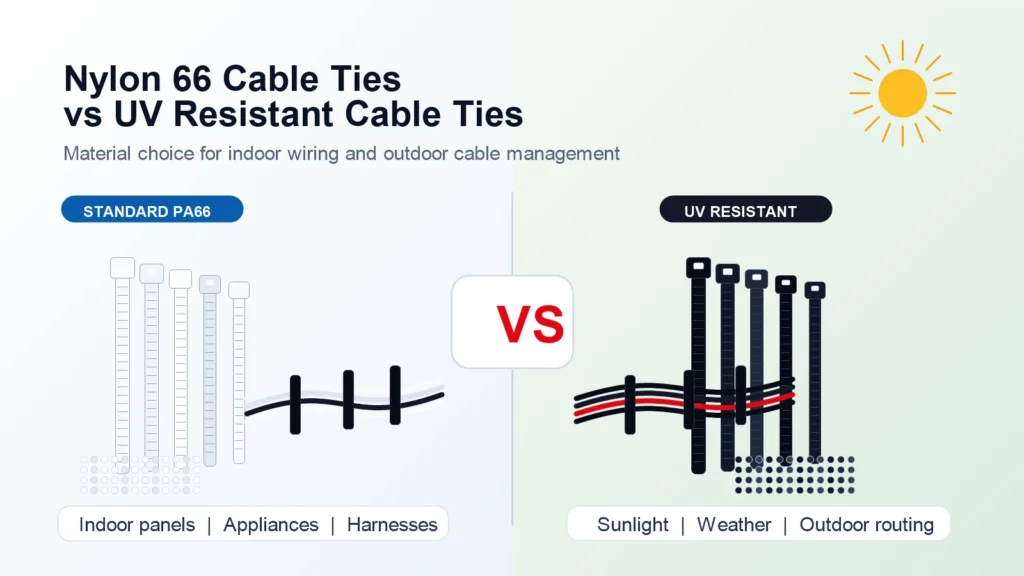


Conclusion: Choose standard PA66 nylon cable ties for protected indoor wiring, appliances, control panels and general bundling. For long-term direct sunlight or outdoor exposure, choose a specific model whose UV-stabilized formulation and test evidence match the expected environment; black color alone does not prove UV resistance. PA66 identifies a base resin category, while UV resistance describes formulation and verified use conditions, so a UV-resistant tie may also use PA66; before bulk ordering, confirm minimum loop tensile strength, installation temperature, operating temperature, weathering evidence, application environment and packaging revision by SKU.
What is the practical difference?
The main difference is the exposure the product is designed and verified to withstand. “PA66,” “black” and “UV resistant” are not interchangeable specifications, so buyers should request the exact formulation description and evidence for the selected model.
| Decision point | Standard PA66 cable ties | Verified UV-resistant cable ties |
|---|---|---|
| Primary environment | Protected indoor or enclosed applications | Outdoor routes with sunlight and weather exposure |
| Common applications | Panels, appliances, harnesses and packaging | Solar PV, telecom, signs and exposed wiring |
| Color | Natural or black options | Often black, but color alone is not evidence |
| Material question | Confirm the PA66 grade and model specification | Confirm UV stabilization, base material and test basis |
| Main buyer checks | Size, tensile strength, temperature and packaging | UV/weathering evidence, temperature, intended service life and location |
| Purchase release | Approve the exact SKU, drawing, sample, test basis and packaging revision | |
When are standard PA66 cable ties the right choice?
Standard PA66 ties are a practical choice for indoor cable bundling, equipment panels, appliance wiring and protected industrial assemblies. The correct size, minimum loop tensile strength and installation conditions still need to match the real application.
Does a black cable tie automatically resist UV?
No. A black tie may contain pigment without having product-specific UV or weathering evidence, so buyers should not use color as the only acceptance criterion.
Describe the exposure
State direct sunlight, climate, moisture, chemicals and the expected installation location.
Ask for evidence
Request the material description, test basis, duration, pass criteria and applicable SKU.
Approve the assembly
Approve samples under representative installation and service conditions before repeat orders.
What is the difference between installation and operating temperature?
Installation temperature describes the condition in which a tie can be handled, bent, inserted and tightened; operating temperature describes the environment after installation. A low operating limit does not automatically prove that the tie can be installed at that same temperature.
How does Haitai evaluate low-temperature risk?
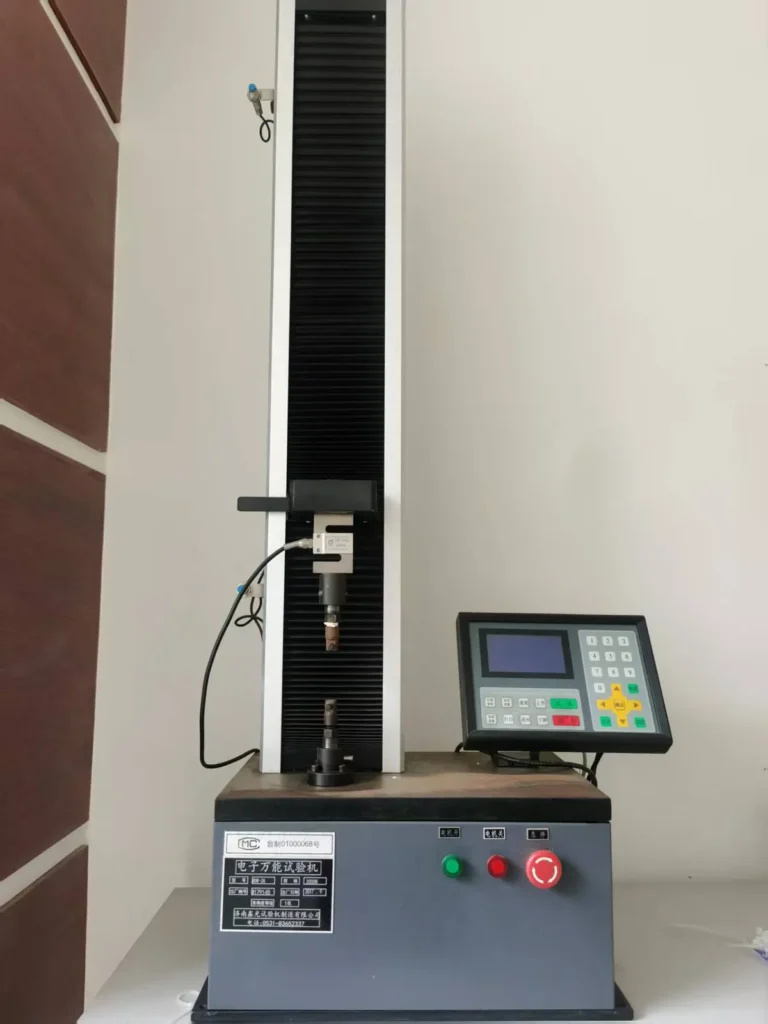
Haitai uses in-house laboratory checks, including a low-temperature V-notch impact method, to evaluate material behavior. This is an internal material-level method and is not represented as the IEC 62275 finished-tie minimum installation temperature test unless the applicable report explicitly documents testing to that procedure.
Why consider Haitai for repeat wholesale or OEM supply?
Established in 1999, Yueqing Haitai Plastics Manufacture Co., Ltd. supports distributors, retail supply chains, electrical customers and OEM programs with cable ties and related services. Customer names and logos remain confidential, while company-level operating facts can be checked against anonymized internal records during qualified buyer review.
Frequently asked sourcing questions
Which cable tie should I use indoors?
Use a standard PA66 tie when the bundle is protected from direct sunlight and the exact size, minimum loop tensile strength and temperature range meet the application.
Which cable tie should I use outdoors?
Use a product with material and UV/weathering evidence for the stated outdoor exposure. Black color by itself is not sufficient proof.
What PA66 grade does Haitai declare?
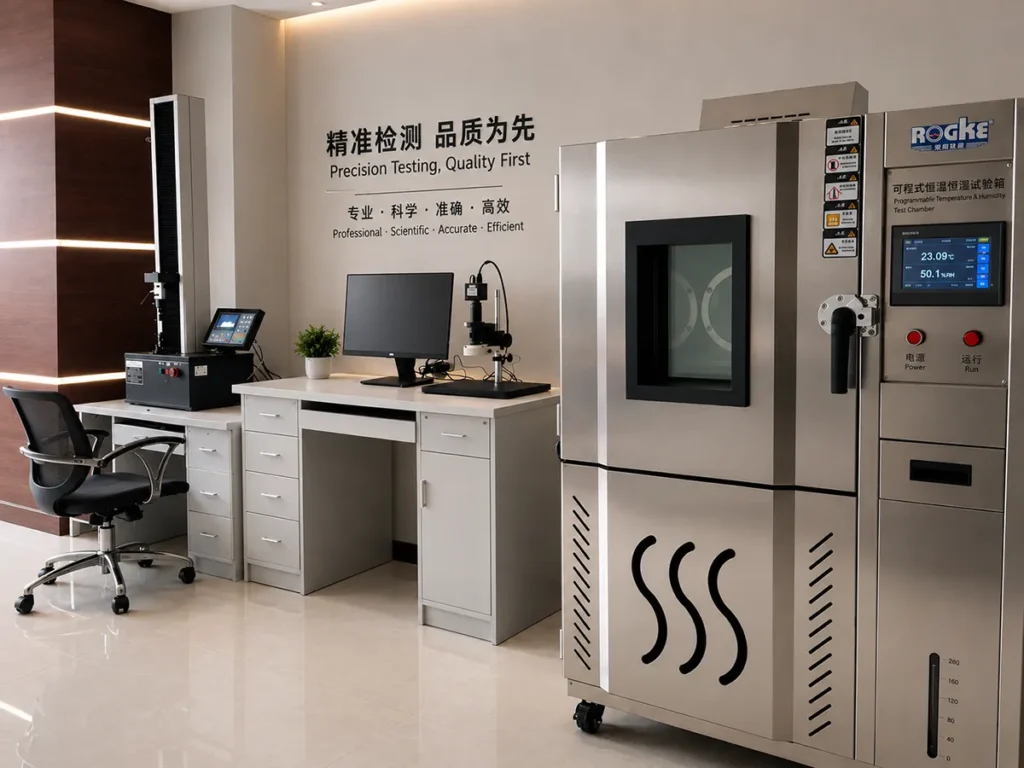
Haitai identifies INVISTA PA66 U4820L for the applicable standard self-locking range. Buyers should request the current SKU specification and batch documentation.
Can applicable Haitai cable ties be installed at −20°C?
The declared installation range is −20°C to +85°C for applicable verified series. Confirm the exact model because installation temperature is different from the published −40°C to +85°C operating range.
What evidence should a buyer request?
Request the current drawing, material grade, tensile test basis, temperature statement, UV/weathering evidence where required, certificate scope, sample and packaging revision for the exact SKU.
Send the environment before choosing the material
Share indoor or outdoor use, sunlight, temperature, chemicals, bundle diameter, strength, quantity and packaging so Haitai can match the application to a current SKU and evidence set.