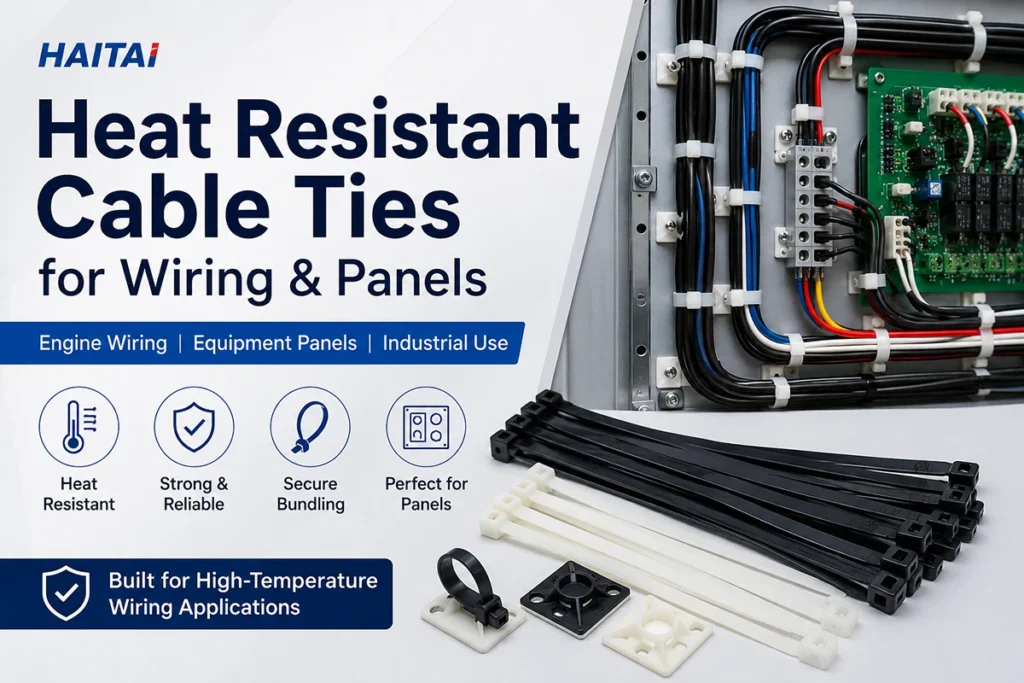


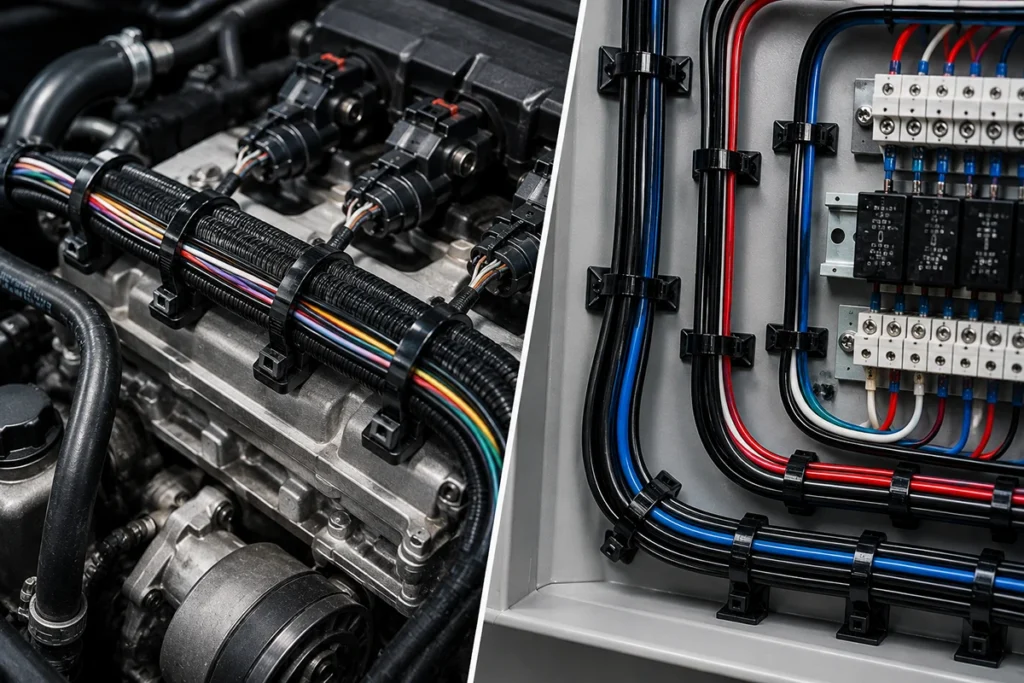
For engine wiring and equipment panels, choose heat resistant cable ties by the temperature at the fastening point, exposure duration and bundle requirements. Haitai’s heat-stabilized PA66 cable ties have a 130°C continuous operating upper limit and an installation range of −20°C to +85°C; for a different temperature profile, compare the PA46 high-temperature range before selecting a model.
Installation temperature describes conditions while fitting the tie, not its in-service temperature limit. Record continuous temperature in °C and any peak exposure in °C and hours separately, then confirm dimensions, loop tensile strength and environmental compatibility.
Warum Hitzebeständigkeit bei der Auswahl von Kabelbindern wichtig ist
PA66HS means heat-stabilized polyamide 66; it is a material category, not one universal finished-tie rating. For Haitai’s PA66HS range, the confirmed continuous operating upper limit is 130°C, while the selected model must still match the fastening point and mechanical requirements.
Assess temperature at the tie’s actual location rather than relying only on a general engine-bay or cabinet reading. Include vibration, contact with chemicals and proximity to hot surfaces in the application brief; a higher temperature rating does not by itself establish chemical compatibility or retained tensile strength.
Häufige Anwendungen für Hitzebeständige Kabelbinder
Hitzebeständige Kabelbinder werden oft dort eingesetzt, wo der Kabelstrang lange Zeit fixiert bleiben muss, ohne sich zu verschieben. Häufige Anwendungen sind:
- Motorraumverkabelung
- Kabelbäume für die Kfz-Wartung
- Bedienfelder
- Schaltschränke
- Industriemaschinen
- Stromverteilerkästen
- Verkabelung von HLK-Anlagen
- Elektrogeräte mit warmen Bereichen im Inneren
In solchen Umgebungen ist eine ordentliche Kabelführung nur ein Teil der Aufgabe. Der Kabelbinder muss zudem gegen Wärmealterung, Vibrationen, Ölnebel, Staub und wiederholte Betriebszyklen beständig sein.
Die Verkabelung des Motors erfordert mehr als nur eine feste Befestigung
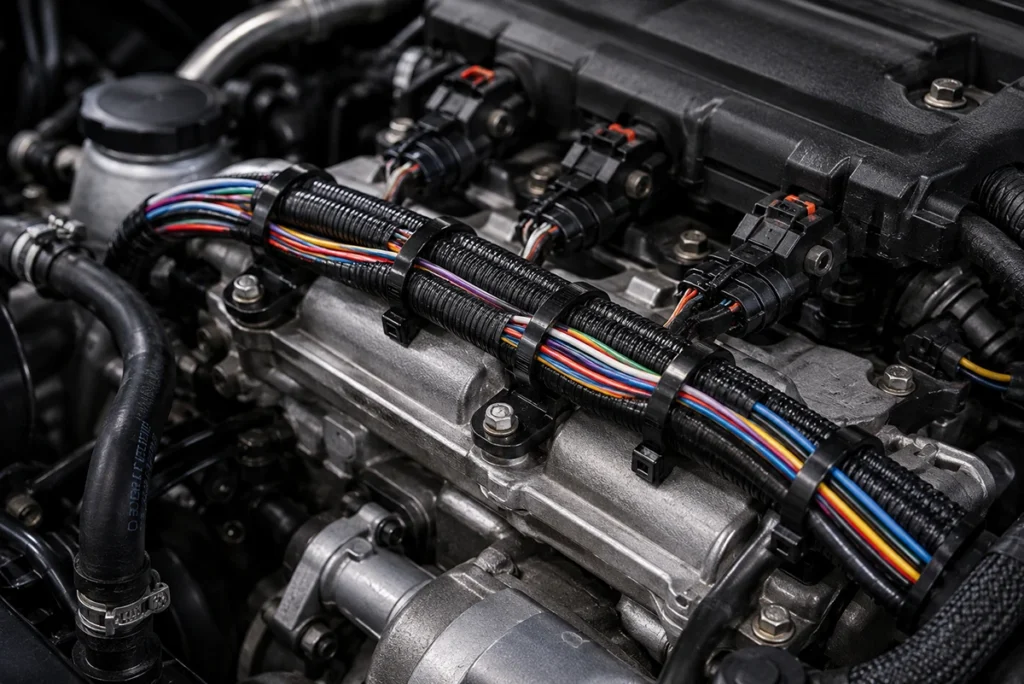
Die Verkabelung im Motorraum ist eine der anspruchsvollsten Anwendungen für Kabelbinder. Der Bereich kann eng, heiß und schwer zugänglich sein. Ein Kabelstrang kann in der Nähe von Metallhalterungen, Schläuchen, Kunststoffabdeckungen und beweglichen Teilen verlaufen. Wenn sich der Kabelbinder lockert, kann das Bündel an benachbarten Komponenten reiben.
Bei der Verlegung auf der Motorseite sollten Käufer auf Folgendes achten:
- Wärmestabilisiertes PA66-Material
- Richtige Breite für die Bündelladung
- Glatte Kanten zur Verringerung von Beschädigungen am Kabelmantel
- Hohe Verriegelungsleistung
- Gleichbleibende Qualität bei Nachbestellungen
- Optionale montierbare oder aufsteckbare Kabelbinder, wenn eine feste Verlegung erforderlich ist
Die Klemme sollte nicht direkt an eine extrem heiße Wärmequelle angelegt werden, wenn die Umgebungstemperatur den für das Material zulässigen Grenzwert überschreitet. In diesem Fall sollte die Verlegung angepasst werden, oder es ist möglicherweise eine andere Befestigungslösung erforderlich.
Gerätepanels und Schaltschränke
For enclosed equipment panels, compare the measured temperature at the fastening point with the selected model’s operating limit. Haitai’s PA66HS cable ties have a 130°C continuous operating upper limit; this does not mean every location in a cabinet requires a high-temperature tie.
For panel wiring, check:
- Bundle diameter and routing space in mm.
- Strap width × length and locking-head clearance.
- Required loop tensile strength in N and relevant test conditions.
- Mounting position, maintenance access and installation-tool settings.
- Color identification, pack quantity and labels for repeat orders.
Review heat-stabilized PA66 cable tie specifications to select a product, and use the engine-compartment application guide when planning automotive routing.
Hitzebeständige vs. flammhemmende Kabelbinder
Diese beiden Begriffe lassen sich leicht verwechseln. Hitzebeständige Kabelbinder sind so konzipiert, dass sie bei erhöhten Temperaturen eine bessere Leistung erbringen. Flammhemmende Kabelbinder sind so konzipiert, dass sie die Anforderungen an die Flammhemmung erfüllen.
Das ist nicht dasselbe.
Ein hitzebeständiger Kabelbinder ist nicht unbedingt flammhemmend. Ein flammhemmender Kabelbinder ist möglicherweise nicht die beste Wahl für den dauerhaften Einsatz bei hohen Temperaturen. Wenn es bei der Anwendung um elektrische Geräte, Brandschutzanforderungen oder spezifische Konformitätsanforderungen geht, sollten Käufer vor der Bestellung die Materialgüte, den Prüfbericht und die vorgesehene Einsatzumgebung überprüfen.
Kurzer Auswahlleitfaden
Compare Haitai PA66HS and PA46 temperature limits
| Product range | Continuous operating upper limit | Installation temperature | Limited-duration high-temperature exposure |
|---|---|---|---|
| Heat-stabilized PA66 / PA66HS | 130°C | −20°C to +85°C | No additional peak rating specified here |
| PA46 high-temperature cable ties | 150°C | Confirm for the selected model | 195°C for up to 500 hours |
These are Haitai’s stated limits for the named product ranges, not universal ratings for all PA66 or PA46 cable ties. The 195°C / 500-hour figure must not be presented as unlimited continuous operation or as the installation temperature.
Match the material to the application
| Bewerbung | Hauptrisiko | Empfohlener Kabelbindertyp | Hinweis für Käufer |
|---|---|---|---|
| Motorkabelbaum | Hitze und Vibration | Hitzestabiles PA66-Kabelbindersortiment | Temperaturprüfung und Bündelbeanspruchung |
| Bedienfelder | Warmer geschlossener Raum | Standard- oder hitzebeständige Kabelbinder | Wählen Sie basierend auf der Schranktemperatur |
| Industriemaschinen | Hitze, Ölnebel, Bewegung | Hitzebeständige Kabelbinder | Betrachten Sie breitere Kabelbinder für schwerere Bündel |
| In der Nähe von Auspuff- oder Turbobereichen | Extreme Strahlungswärme | Spezielle Befestigungslösung | Verlassen Sie sich nicht ausschließlich auf Nylonbinder |
| Klimaanlagen | Warme Luftströmung und Vibration | Hitzebeständige Kabelbinder | Alterungsleistung bestätigen |
| Service-Kabelbäume | Überarbeitung und Wartung | A releasable design only if its own temperature rating matches the application | Wählen Sie je nach Servicehäufigkeit |
Wie man die richtige Größe auswählt
Start with minimum and maximum bundle diameter in mm, then specify strap width × length and locking-head clearance. Use the cable tie size chart to prepare the dimensional requirement, but confirm the PA66HS or PA46 version of the selected model rather than transferring a standard PA66 specification.
State the required loop tensile strength in N together with the application temperature and relevant conditioning. Loop tensile strength is not a safe working-load rating; the cable tie tensile strength guide explains the purchasing information to request.
Include an installation photo or drawing if the tie must fit a panel hole, bracket or restricted space. Dimensions, material and environmental requirements should be agreed together before sample approval.
Überlegungen zu Material und Farbe
PA66HS identifies heat stabilization; black or natural color does not by itself establish UV resistance. If sunlight exposure is expected, specify it separately and request the relevant documentation for the selected compound and finished model.
Treat temperature, UV exposure and flame classification as separate requirements rather than interchangeable claims. The PA66 versus UV-resistant cable tie guide provides a separate outdoor-selection checklist.
Zu vermeidende Fehler bei der Installation
Auch ein gutes Kabelbinder kann bei falscher Installation frühzeitig versagen. In heißen Gebieten werden kleine Installationsfehler mit der Zeit größer.
Vermeiden Sie diese häufigen Probleme:
- Die Befestigung wird zu nahe an einer direkten Wärmequelle angebracht
- Die Klemme so fest anziehen, dass die Isolierung des Kabels beschädigt wird
- Verwendung einer für das Bündel zu schmalen Bindeschnur
- Den Verriegelungskopf an einer scharfen Kante anliegen lassen
- Das Mischen unterschiedlicher Materialqualitäten in einer Produktionscharge
- Die Auswahl erfolgt ausschließlich nach der Länge statt nach der Breite und der Festigkeit
- Vibrationen und Bewegungen nach der Installation ignorieren
Bei einer ordnungsgemäßen Montage sollte der Kabelbaum fest gehalten werden, ohne ihn zu quetschen. Das Kabelbündel sollte an seinem Platz bleiben, die Kabelummantelung darf jedoch nicht eingeklemmt oder verformt werden.
Was Käufer vor der Bestellung überprüfen sollten
For a bulk or OEM quotation, provide the material range, strap width × length in mm, bundle diameter in mm and required loop tensile strength in N. State installation temperature, continuous operating temperature and any higher-temperature exposure with its duration separately.
Include:
- Quantity by model and color.
- Contact with oil, cleaning agents or other chemicals.
- Sunlight exposure and any required flame classification.
- Pack quantity in pcs/bag, carton marks and private-label artwork.
- Required drawings, test conditions and model-specific certificate scope.
- Sample-approval requirements, destination and requested delivery date.
Request heat resistant cable tie samples or a quotation from Haitai with these details. Specify PA66HS or PA46 so the reply can be matched to the correct material and temperature profile.
Abschließende Gedanken
Hitzebeständige Kabelbinder sind ein kleiner Teil des Verkabelungssystems, haben aber einen direkten Einfluss auf die Leitungsqualität und die langfristige Zuverlässigkeit. Für Bordverkabelungen, Schalttafelmontagen und industrielle Kabelbäume sollte der richtige Kabelbinder auf das Hitzenniveau, die Bündelgröße, die Befestigungslast und den Installationsraum abgestimmt sein.
Wenn die Anwendung in der Nähe von Wärme, Vibrationen oder abgeschlossenen elektrischen Komponenten liegt, wählen Sie nicht nur nach Preis oder Länge aus. Beginnen Sie mit der Arbeitsumgebung und bestätigen Sie dann Material, Größe, Festigkeit und Verpackung. Dies ist der sicherste Weg, um eine Kabelmanagementlösung zu erstellen, die in der Produktion funktioniert und im Betrieb zuverlässig bleibt.
Häufig gestellte Fragen
Wofür werden Hitzebeständige Kabelbinder verwendet?
They are used to bundle wiring in temperature-exposed locations such as equipment panels, industrial machinery and selected engine-compartment positions. Haitai’s PA66HS range has a 130°C continuous operating upper limit; check the specific fixing point rather than assuming every location has the same conditions.
Sind hitzebeständige Kabelbinder dasselbe wie UV-beständige Kabelbinder?
No: heat stabilization and UV resistance address different exposure requirements. If both are needed, confirm both properties for the selected compound and finished model; color alone is not evidence.
Was ist das übliche Material für hitzebeständige Kabelbinder?
Heat-stabilized PA66 (PA66HS) is one option; Haitai specifies a 130°C continuous operating upper limit and −20°C to +85°C installation for this range. Haitai’s separate PA46 range has a 150°C continuous operating upper limit and permits 195°C for up to 500 hours, not unlimited service at 195°C.
Kann ich Standard-Nylon-Kabelbinder im Motorraum verwenden?
Only if the selected finished tie’s documented temperature and environmental limits cover the actual fixing point. Do not assume standard PA66 and PA66HS share the same rating, and do not use a loop tensile figure as a safe working-load rating.
Wie wähle ich die richtige Größe?
Provide bundle diameter, strap width × length and available routing clearance in mm, plus the required loop tensile strength in N. Confirm these with the selected heat-resistant material and test conditions, rather than selecting by length alone.