





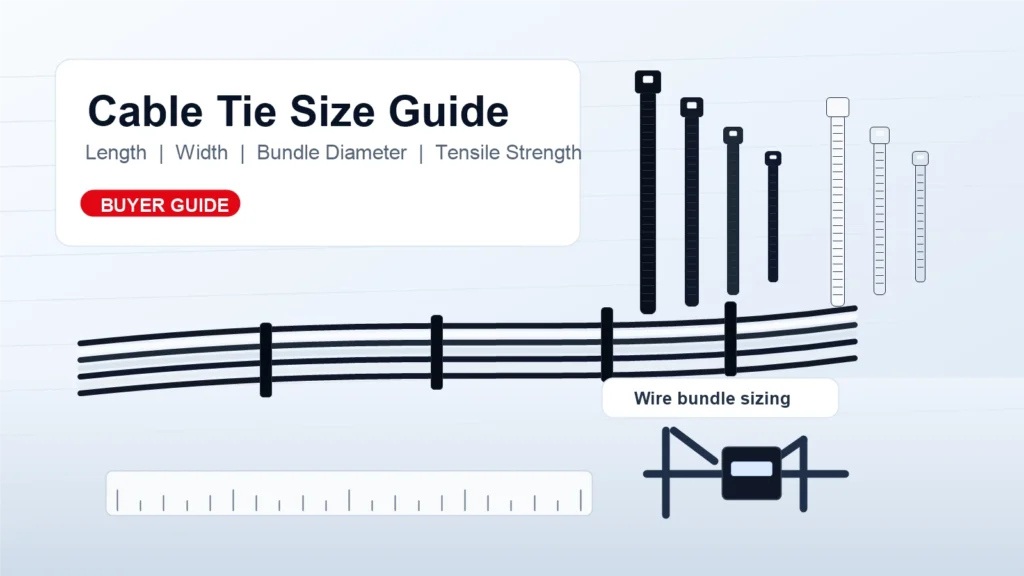
Cable Tie Size Guide is not just about picking the longest tie on the shelf. For buyers, installers, and distributors, the right cable tie size affects how clean the wiring looks, how stable the bundle stays, and how much trouble the assembly team avoids later. A good choice usually comes down to five things: bundle diameter, cable tie length, cable tie width, tensile strength, and material grade.
If the tie is too short, workers waste time forcing it around the bundle. If it is too narrow, the lock may not hold well enough for the application. If it is oversized, the installation looks bulky and the cost goes up for no real reason. This guide gives a practical way to choose nylon cable ties for wire harnesses, equipment panels, appliances, automotive wiring, outdoor routing, and general industrial cable management.
For product options, review Haitai’s nylon cable ties and wiring accessories.
Quick Answer: How Do You Choose the Right Cable Tie Size?
The fastest way is to measure the wire bundle diameter first, then choose a tie length that can wrap around the bundle with enough tail length for locking and handling. After that, choose the width and tensile strength based on load, vibration, routing space, and material environment.
- For small signal wires, use a narrow cable tie with light-duty strength.
- For general wire harnesses, choose a medium-width nylon cable tie.
- For thick cable bundles, moving equipment, or higher vibration areas, use a wider tie with higher tensile strength.
- For outdoor cable routing, choose UV resistant material.
- For hot areas, choose heat stabilized nylon.
That is the short version. The sections below explain how to make the decision with fewer mistakes.
Why Cable Tie Size Matters
A cable tie looks simple, but in production it does a very specific job. It holds wires in a fixed route, keeps the bundle away from moving parts, improves the appearance of an assembly, and helps the final product stay serviceable. Size is part of that performance.
A small tie may be fine for a control panel signal wire, but the same tie is not suitable for a heavy cable bundle or a harness exposed to vibration. On the other side, a very wide tie may hold strongly, but it may not fit into a tight panel slot or around a compact harness.
For distributors, size selection also affects inventory. Stocking every size is not always necessary. Most buyers can cover common orders with several practical groups: small ties for light wiring, medium ties for general harnesses, longer ties for large bundles, and special materials for outdoor or high-temperature use.
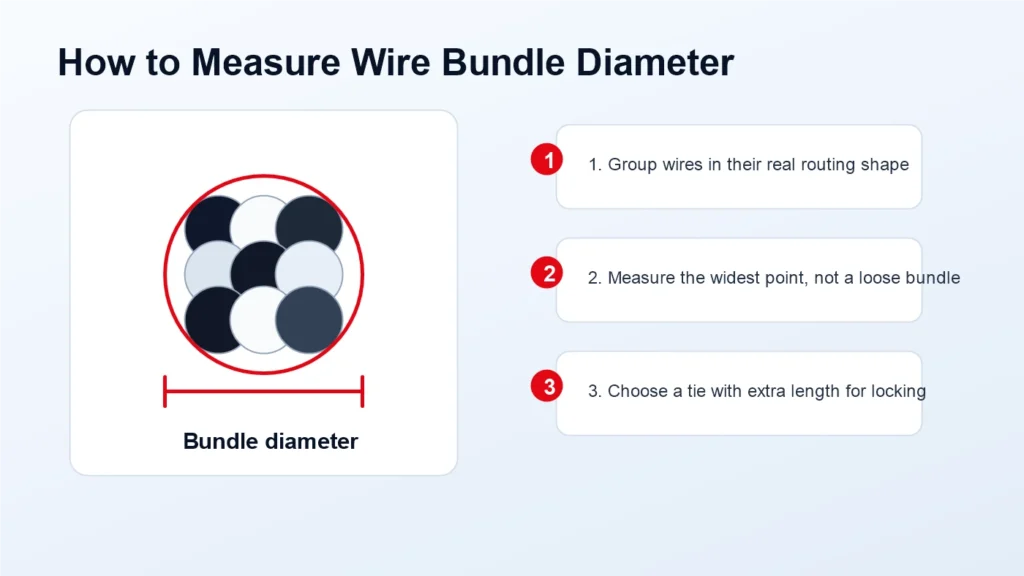
Step 1: Measure the Wire Bundle Diameter
A cable tie looks simple, but in production it does a very specific job. It holds wires in a fixed route, keeps the bundle away from moving parts, improves the appearance of an assembly, and helps the final product stay serviceable. Size is part of that performance.
A small tie may be fine for a control panel signal wire, but the same tie is not suitable for a heavy cable bundle or a harness exposed to vibration. On the other side, a very wide tie may hold strongly, but it may not fit into a tight panel slot or around a compact harness.
For distributors, size selection also affects inventory. Stocking every size is not always necessary. Most buyers can cover common orders with several practical groups: small ties for light wiring, medium ties for general harnesses, longer ties for large bundles, and special materials for outdoor or high-temperature use.
Step 2: Choose Cable Tie Length
Cable tie length decides the maximum bundle size the tie can wrap around. In real purchasing, length is usually the first number buyers check.
A short cable tie is useful for small wires, light panel work, and compact electronic assemblies. Medium lengths are more common for appliances, machinery panels, and ordinary wire harnesses. Long cable ties are used for thick cable bundles, packaging, pipe fixing, and larger routing spaces.
One practical point: the listed cable tie length is not the same as the usable bundle diameter. Part of the tie is used by the locking head and the tail needs enough length for tightening. So if the measured bundle is close to the maximum fit, move up to the next length.
This is especially important when workers use gloves, when the harness is stiff, or when the bundle includes corrugated tubing.
Step 3: Choose Cable Tie Width
Width is easy to overlook, but it strongly affects holding performance. A wider cable tie usually gives better strength and a larger contact area. That helps when the cable bundle is heavier, when the tie is used in a vibrating area, or when the harness should not shift after installation.
Narrow ties are good for light-duty wire organization. They are flexible, easy to handle, and suitable for compact spaces. Medium-width ties are the most common choice for general wire harness routing. Wide ties are better for thick bundles, industrial equipment, and applications where stronger fastening is required.
The key is balance. A cable tie should be strong enough for the job, but not so large that it makes the harness hard to service or fit.
Step 4: Check Tensile Strength
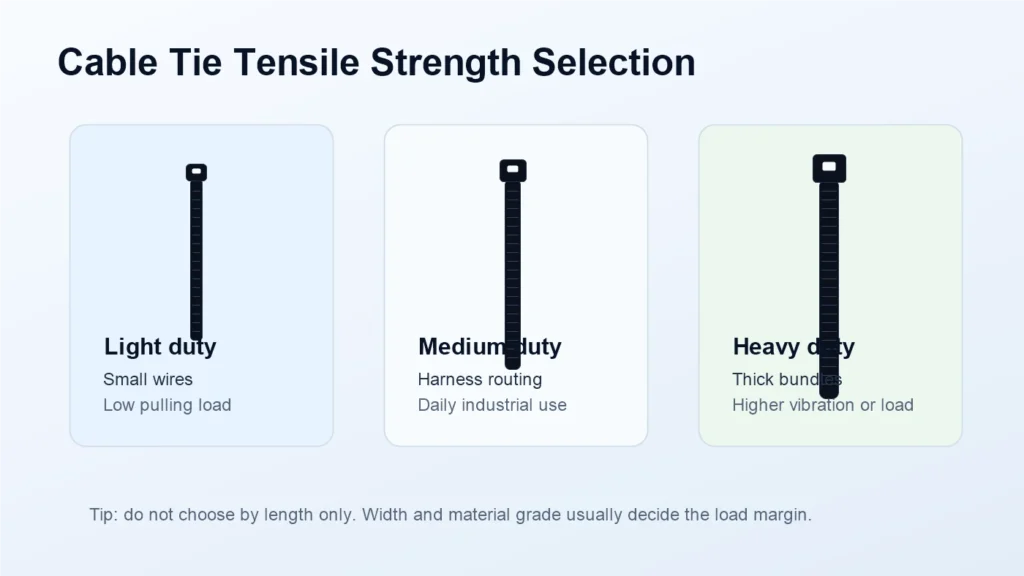
Tensile strength tells you how much pulling force a cable tie can handle before failure. It is not the only performance factor, but it is one of the most important for industrial buyers.
For a small indoor wire bundle, light-duty tensile strength may be enough. For a general harness, medium-duty strength gives a safer margin. For heavy bundles, vibration-prone areas, or installations where the tie carries more load, a stronger cable tie is the better choice.
A common mistake is choosing by length only. Two cable ties may have similar lengths but very different widths and tensile strength. If the application involves movement, heat, outdoor exposure, or repeated service handling, tensile strength and material grade should be checked before ordering.
If you are not sure which strength level fits your project, send the bundle diameter, application environment, and expected packing quantity through the contact page for size and packaging support.
Step 4: Check Tensile Strength
| Bundle need | Typical length | Typical width | Strength level | Best use |
|---|---|---|---|---|
| Small signal wires | 100-150 mm | 2.5-3.6 mm | Light duty | Control panels |
| General harness | 150-250 mm | 3.6-4.8 mm | Medium duty | Appliances, equipment |
| Thick cable bundle | 250-370 mm | 4.8-7.6 mm | Heavy duty | Industrial routing |
| Outdoor routing | 200-370 mm | 4.8-7.6 mm | UV resistant | Solar and outdoor runs |
| Hot areas | 150-300 mm | 3.6-7.6 mm | Heat stabilized | Engine-side routing |
Tensile strength tells you how much pulling force a cable tie can handle before failure. It is not the only performance factor, but it is one of the most important for industrial buyers.
For a small indoor wire bundle, light-duty tensile strength may be enough. For a general harness, medium-duty strength gives a safer margin. For heavy bundles, vibration-prone areas, or installations where the tie carries more load, a stronger cable tie is the better choice.
A common mistake is choosing by length only. Two cable ties may have similar lengths but very different widths and tensile strength. If the application involves movement, heat, outdoor exposure, or repeated service handling, tensile strength and material grade should be checked before ordering.
If you are not sure which strength level fits your project, send the bundle diameter, application environment, and expected packing quantity through the contact page for size and packaging support.
Nylon 66, UV Resistant, and Heat Stabilized Options
Material matters as much as size. Most general cable ties are made from nylon 66 because it offers a good balance of strength, flexibility, and cost. For indoor wire bundling, standard nylon 66 is often enough.
For outdoor cable management, black UV resistant cable ties are usually preferred. They are more suitable for sunlight exposure and outdoor cable runs. For engine-side routing or warm equipment areas, heat stabilized cable ties are a better fit because ordinary nylon may age faster near heat.
For applications that need easier maintenance, releasable cable ties can help technicians open and adjust the bundle without cutting every tie. For general background on cable tie design and use, see this external cable tie overview.
Common Cable Tie Size Mistakes
- Using the same cable tie for every job. It may simplify purchasing, but it often creates poor fit in production.
- Choosing a tie that barely reaches around the bundle. A cable tie should leave enough tail length for proper tightening.
- Ignoring the locking head. In tight spaces, the head position can affect whether the harness fits cleanly.
- Using indoor material outdoors. If the cable tie will face sunlight, rain, or outdoor temperature changes, material selection becomes important.
- Not testing the tie with the real harness. A drawing is useful, but the final check should use actual wires, sleeves, connectors, and routing clips.
How Buyers Should Confirm Size Before Bulk Orders
For OEM and distributor orders, it is worth confirming three things before placing a large order.
First, confirm the bundle diameter and cable route. A straight bundle and a curved harness may need different tie lengths. Second, confirm the environment. Indoor cabinets, outdoor solar frames, appliance wiring, and automotive harnesses do not have the same material requirements.
Third, confirm packaging. Some buyers need bulk bags, small retail packs, carton labels, barcodes, or mixed-size assortments. Size selection should match how the product will be stored and sold.
If you need related questions answered before ordering, the FAQ page is a useful internal reference.
Final Recommendation
A good Cable Tie Size Guide should start with the real wire bundle, not only the catalog. Measure the bundle diameter, choose enough length, match the width to the load, check tensile strength, and select the right material for the working environment.
For most buyers, the safest approach is to prepare a small size range rather than depend on one universal tie. That gives installers cleaner routing, reduces waste, and makes repeat orders easier to control.
For cable tie sizes, packaging, and OEM supply support, visit Haitai’s product page or send a request through Contact Us.
FAQs About Cable Tie Sizes
What size cable tie should I use for a wire bundle?
Measure the bundle diameter first, then choose a tie long enough to wrap the bundle with extra tail length for locking. For general harnesses, medium-width nylon cable ties are often a practical starting point.
Is a wider cable tie always better?
No. A wider tie usually provides more strength, but it may be too bulky for small wires or tight panel spaces. Use a wider tie when the bundle is heavier, exposed to vibration, or requires stronger fastening.
How much extra cable tie length do I need?
Leave enough length for the locking head and tightening tail. If the tie only barely reaches around the bundle, choose the next longer size.
What cable tie material is best for outdoor use?
For outdoor cable routing, UV resistant cable ties are usually a better choice than standard natural nylon ties.
Can one cable tie size cover all applications?
It can cover some general jobs, but not all. A better purchasing plan usually includes small, medium, long, and special-material options.